
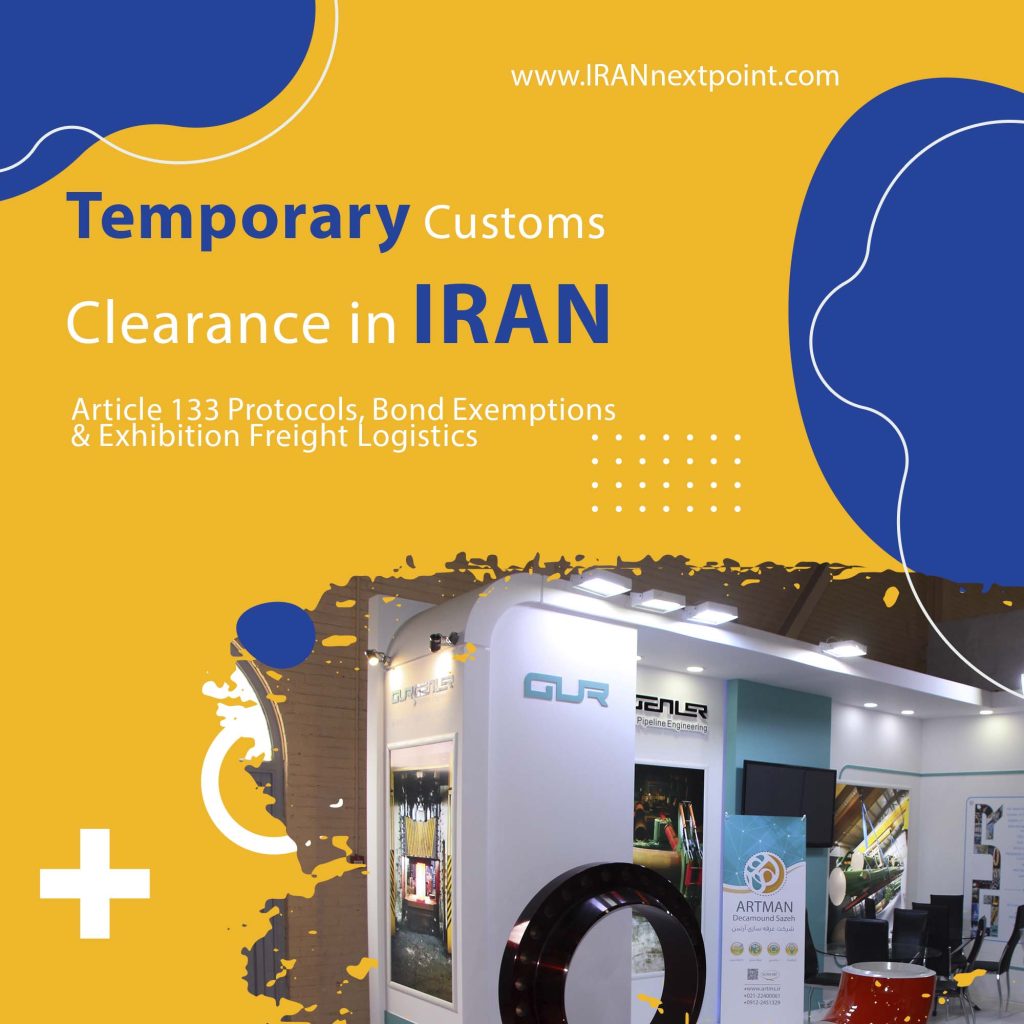
Navigating Cross-Border Exhibition Logistics Under Iranian Customs Law
International participation in trade fairs across Iran represents an effective mechanism for testing regional commercial markets. Foreign enterprises frequently dispatch sophisticated industrial machinery, heavy plant prototypes, laboratory instruments, and marketing fixtures to evaluate consumer appetite. However, foreign corporate managers often encounter severe regulatory hurdles at border entries. Transporting commercial cargo into Iran without understanding statutory customs frameworks creates immediate operational disruption. Therefore, navigating temporary customs clearance Iran requires systematic alignment with domestic statutory mandates from the earliest project planning phases.
The Islamic Republic of Iran Customs Administration (IRICA) enforces strict procedural protocols over temporary cargo intake. Many international commercial directors assume that exhibition assets move under informal administrative waivers. In reality, Iranian border checkpoints strictly inspect all incoming equipment. Failing to declare cargo accurately leads to prolonged port detentions, punitive customs fines, or direct asset confiscation. To execute a compliant event presence, foreign enterprises rely on established partners. Exploring our licensed operations as an integrated turnkey EPCC contractor in Iran confirms our operational capacity across national supply lines. Furthermore, cross-referencing your event timeline against our active Iran trade exhibition calendar ensures adequate transit buffer windows.
1. Statutory Foundations: Deciphering Article 133 of the Iranian Customs Law
The primary legal pillar governing temporary cargo intake for trade fairs is codified under Article 133 of the Iranian Customs Law (Ghanon-e Omor-e Gomroki). In standard commercial import scenarios, enterprises must obtain formal Ministry of Industry import licenses, establish currency banking allotments, and pay definitive customs duties. Conversely, Article 133 creates a specialized statutory exemption specifically designed for foreign enterprises participating in recognized commercial exhibitions.
According to analytical trade data reported by the Iranian Students’ News Agency (ISNA), goods intended for public display or dynamic operational demonstration enter domestic territory under conditional duty waivers. Under Article 133 protocols, foreign participants avoid definitive commercial import taxes. However, the temporary admission framework operates under strict contractual commitments. The exhibiting firm formally pledges that all incoming equipment will depart domestic territory immediately following the conclusion of the specified trade exhibition.
Article 133 temporary admission applies strictly to authorized categories of trade fair assets:
- Industrial Machinery and Functional Equipment: Complex plant prototypes, production lines, processing machinery, and testing equipment intended for physical display or operational demonstration inside the fairgrounds.
- Specialized Exhibition Pavilion Modules: Custom architectural components, modular aluminum profiles, bespoke retail fixtures, and digital presentation totems utilized exclusively within stand parameters.
- Promotional Display Samples: High-value trade specimens, analytical instruments, and diagnostic apparatus intended to demonstrate technical capabilities to prospective commercial partners.
- Commercial Literature and Catalogs: Specialized printed marketing collateral, bilingual catalogs, and commercial folders distributed during official exhibition operational hours.
Crucially, Article 133 strictly excludes consumables intended for open public sale or unrestricted domestic consumption. Consumer goods, perishable food items, and retail inventory cannot enter under temporary exhibition status. Treating commercial inventory as temporary exhibition cargo constitutes a serious administrative violation under IRICA regulations. When planning multi-tiered market engagements, coordinate directly with our specialized corporate legal compliance division to ensure structural trade alignment.
2. Procedural Mechanics: Temporary Entry Permits and Article 50 Commitments
To access the statutory benefits of Article 133, international exhibitors must satisfy the procedural prerequisites detailed under Article 50 of the Executive By-Laws of the Customs Law. As comprehensively outlined by trade intelligence platforms like NTS Team Customs Advisory, securing an official Temporary Import Permit (Mojavez-e Vorood-e Movaghat) requires an extensive pre-clearance administrative file before cargo reaches Iranian frontier checkpoints.
The primary prerequisite involves obtaining an official Letter of Accreditation issued by the recognized exhibition organizing authority. The fairground organizers must formally certify that the foreign applicant is an officially registered exhibitor possessing an approved, paid stand allocation. This accreditation letter explicitly identifies the foreign entity, specifies designated hall coordinates, and references the exact dates of the scheduled commercial fair. IRICA border inspectors immediately reject temporary admission declarations that lack this authenticated organizer certification.
Furthermore, foreign enterprises must present a comprehensive pro-forma invoice and packing manifest containing verified technical data points:
- Granular Item Descriptions: Exact technical designations, industrial model numbers, and serial markings for every individual mechanical unit.
- Harmonized System (HS) Codes: Accurate 8-digit tariff classifications reflecting the precise engineering nature of each equipment component.
- Standardized Value Declarations: Defensible CIF (Cost, Insurance, and Freight) valuations verified by foreign manufacturer documentation.
- Dimensional and Weight Metrics: Detailed gross and net weight specifications alongside individual crate dimensions for physical customs tallying.
Once IRICA reviews the pre-clearance documentation, border authorities establish the statutory duration of the temporary admission. Standard temporary import authorizations span three months, encompassing transit periods, exhibition operational days, and return logistics windows. While exhibitors may request formal timeline extensions under extraordinary logistical delays, these requests require direct ministerial approval prior to initial permit expiry dates.
3. Financial Guarantees: Bank Bonds, Cash Deposits, and ATA Carnet Protocols
A fundamental misconception held by foreign delegates is that temporary customs admission requires zero financial commitment. Under Iranian customs jurisprudence, temporary admission waives immediate duty payments but mandates robust financial security. IRICA demands binding collateral to ensure foreign cargo does not divert illicitly into the domestic commercial market.
As documented by trade logistics authorities at iXport Customs Trade Group, foreign exhibitors must furnish financial guarantees equal to the full calculated import duties plus punitive surcharges. IRICA accepts three standardized modalities of customs collateral:
- Direct Cash Deposits (Vadi-eh Naghdi): Exhibitors deposit the full assessed customs valuation directly into designated IRICA treasury escrow accounts at entry ports. While fully refundable, cash deposits present severe international foreign exchange risks during post-show repatriation.
- Domestic Bank Guarantees (Zemanat-Nameh Banki): A licensed Iranian commercial bank issues an unconditional, irrevocable payment guarantee in favor of IRICA. This mechanism avoids tying up liquid cash but requires established domestic banking conduits or licensed local corporate sponsors.
- The International ATA Carnet System: The most efficient mechanism for eligible international corporations. Iran is an active contracting party to the ATA Convention administered by the International Chamber of Commerce (ICC). When utilizing an authentic ATA Carnet, the carnet booklet serves as an internationally recognized customs guarantee, completely replacing domestic cash deposits.
Utilizing the ATA Carnet mechanism streamlines border crossings significantly. However, foreign delegates must ensure that local customs officers at Iranian frontier points accurately validate, sign, and detach the proper counterfoils upon arrival and departure. An un-stamped voucher prevents carnet discharge, resulting in severe claims by international issuing associations. For comprehensive operational management of physical pavilions, engage our accredited exhibition stand contractor in Iran engineering units.
4. Port Entry to Fairground Transit: Internal Transit and Dedicated Venue Customs Desks
Cargo dispatch into Iran typically enters via primary commercial conduits, including Imam Khomeini International Airport (IKIA) for airfreight, Bandar Abbas for sea containers, or Bazargan for overland European trucking fleets. International exhibitors must never attempt to perform definitive cargo clearance at these high-density frontier checkpoints. Frontier customs stations operate under massive throughput pressure and lack specialized exhibition processing protocols.
Instead, accredited logistics contractors declare arriving exhibition cargo under a regime of Internal Bonded Transit (Passavand-e Dakheli). Under internal transit manifests, sealed shipping containers transit under customs escort directly from the frontier checkpoint to the specialized exhibition customs branch. Crucially, the Tehran International Permanent Fairground maintains an active, on-site customs administration office operating directly within the fairground perimeter.
Executing bonded transit directly to the fairground provides decisive operational advantages:
- On-Site Physical Inspections: Technical cargo examinations occur directly on the fairground concourse, avoiding packaging damage inside congested maritime sea terminals.
- Specialized Administrative Handling: Fairground customs inspectors understand temporary exhibition protocols and handle sensitive engineering equipment with care.
- Direct Stand Delivery: Once on-site customs officials examine serial numbers against shipping manifests, cargo moves directly to the designated exhibition hall without intermediate warehousing delays.
Furthermore, our operational teams maintain specialized staging depots in Evin, situated minutes from the fairground’s northern entry gates. This immediate spatial proximity allows our logistics teams to coordinate heavy crane operations, flatbed transit, and emergency replacement deliveries without getting trapped in severe metropolitan expressway traffic along the Chamran corridor.
5. Strict Prohibitions: Unauthorized Commercial Diversion and Smuggling Liabilities
The operational framework of Article 133 temporary admission strictly prohibits commercial exploitation outside the designated exhibition stand. Foreign participants frequently assume that once equipment clears customs, they may sell, donate, or leave the machinery inside Iran. This assumption triggers immediate, catastrophic criminal and financial penalties under domestic law.
Under Article 133 statutes, temporary admission goods remain under continuous statutory customs surveillance. Exhibitors are strictly forbidden from executing any of the following unauthorized actions:
- Unauthorized Domestic Sale: Selling exhibition machinery to local Iranian buyers directly from the booth without prior formal customs conversion and tariff clearance.
- Physical Alteration or Processing: Modifying, machining, disassembling, or consuming temporary exhibition assets in any manner that alters the original manifest state.
- Unauthorized Spatial Relocation: Transferring equipment from the fairground to private domestic warehouses, corporate offices, or provincial factories without written IRICA transit permits.
Under Article 113 of the Iranian Customs Law, diverting temporary admission cargo into domestic consumption without prior customs authorization constitutes the statutory offense of Commercial Smuggling (Ghaachagh-e Gomroki). If an exhibitor sells machinery from the stand without authorization, IRICA immediately confiscates the posted financial guarantee. Furthermore, authorities assess punitive administrative fines ranging from two to five times the full commercial asset valuation. In severe cases, corporate directors face formal judicial travel bans (Mamno-ol-Khorooj) preventing departure from Iran until all legal adjudications conclude. Managing these complex regulatory thresholds requires experienced corporate guidance; examine our strategic breakdown on how to choose an exhibition stand contractor in Iran to ensure reliable on-site representation.
6. Post-Exhibition Protocols: Re-Exportation Procedures Versus Definitive Import Conversion
When the commercial exhibition concludes, the temporary admission cycle enters its most critical compliance phase. International exhibitors face two distinct operational pathways: executing complete re-exportation back to the country of origin, or converting temporary exhibition assets into definitive commercial imports for a domestic buyer.
If the foreign enterprise elects to re-export the machinery, the contractor initiates the re-exportation protocol (Marjoo-i). The fairground on-site customs inspectors perform a comprehensive visual audit, cross-referencing serial numbers, physical weights, and mechanical features against the original entry declaration. Following successful verification, customs officers apply official seals to the transport containers, issue the formal Bill of Lading clearance, and cancel the active bank guarantee or discharge the ATA Carnet voucher. Shipping assets then move under customs bond back to outbound international ports.
Alternatively, foreign exhibitors frequently secure commercial purchase agreements with Iranian industrial buyers during the exhibition. In this scenario, the equipment does not require physical re-exportation. However, the parties must execute a formal Conversion of Declaration (Tabdil-e Ezharnameh) before the temporary permit expires:
- Ministry Commercial Order Registration: The domestic Iranian buyer must secure an official Commercial Order Registration (Sabt-e Sefaresh) through the Ministry of Industry, Mine, and Trade (MIMT).
- Foreign Exchange Allotment: The buyer must allocate compliant foreign currency conduits through the Central Bank of Iran banking networks.
- Definitive Duty Settlement: The buyer pays full commercial import tariffs, value-added taxes (VAT), and regulatory fees directly to IRICA.
- Statutory Bond Discharge: Once IRICA processes the definitive import declaration, authorities officially release the foreign exhibitor’s original temporary bond.
If your enterprise plans to transition from temporary trade shows to permanent market operations, establishing permanent retail presence becomes essential. Our specialized turnkey retail construction divisions deliver full-scope store fit-outs, regional warehouse procurement, and commercial manufacturing facilities across major Iranian economic centers.
7. Step-by-Step Strategic Roadmap for International Exhibitors
To prevent operational disruptions, foreign project directors must execute customs compliance systematically. Implementing the following step-by-step verification roadmap guarantees smooth logistics execution across all stages:
- Day -90 Before Opening: Finalize functional spatial plots and secure formal organizer accreditation documentation. Determine whether incoming equipment moves under an ATA Carnet or via domestic bank guarantees.
- Day -60 Before Opening: Prepare complete bilingual packing lists containing exact HS codes, machine serial numbers, dimensional weights, and certified CIF valuations.
- Day -45 Before Opening: Submit the pre-clearance administrative file to IRICA and obtain formal Temporary Admission Authorizations (Article 133).
- Day -20 Before Opening: Dispatch freight via accredited international forwarders, designating the bill of lading to the specialized Tehran Fairground Customs Desk under internal bonded transit.
- Day -5 Before Opening: Receive sealed containers on the fairground concourse. Supervise on-site customs physical inspections alongside certified supervising engineers.
- Day +1 After Closing: Secure equipment inside the stand immediately. Prepare cargo for final re-exportation audits or initiate Ministry order registrations for definitive local purchase conversion.
Following this structured timeline eliminates administrative confusion, protects corporate capital, and ensures seamless compliance with Iranian commercial regulations.
8. Comprehensive EPCC Support: Securing Your Cross-Border Trade Success
Operating in Iran’s commercial landscape requires specialized domestic engineering and legal expertise. International corporations cannot afford logistics breakdowns during time-sensitive commercial exhibitions. Working with an integrated Engineering, Procurement, Construction, and Commissioning (EPCC) contractor eliminates administrative friction and provides continuous operational accountability.
IranNextPoint bridges the gap between international corporate standards and Iranian regulatory frameworks. We manage temporary customs clearances under Article 133, coordinate with venue authorities, secure municipal engineering approvals, and fabricate bespoke exhibition stands within our dedicated industrial workshops. Furthermore, our strategic proximity to major fairgrounds ensures immediate technical response to any unforeseen logistical challenge.
Protect your exhibition investments and secure smooth cross-border execution. For confidential customs reviews, stand fabrication tenders, or corporate market entry consultations, reach out directly to our technical departments. Connect with our engineering desk at projects@irannextpoint.com, contact our administrative directors at info@irannextpoint.com, or submit your commercial inquiry directly through our corporate contact portal.