
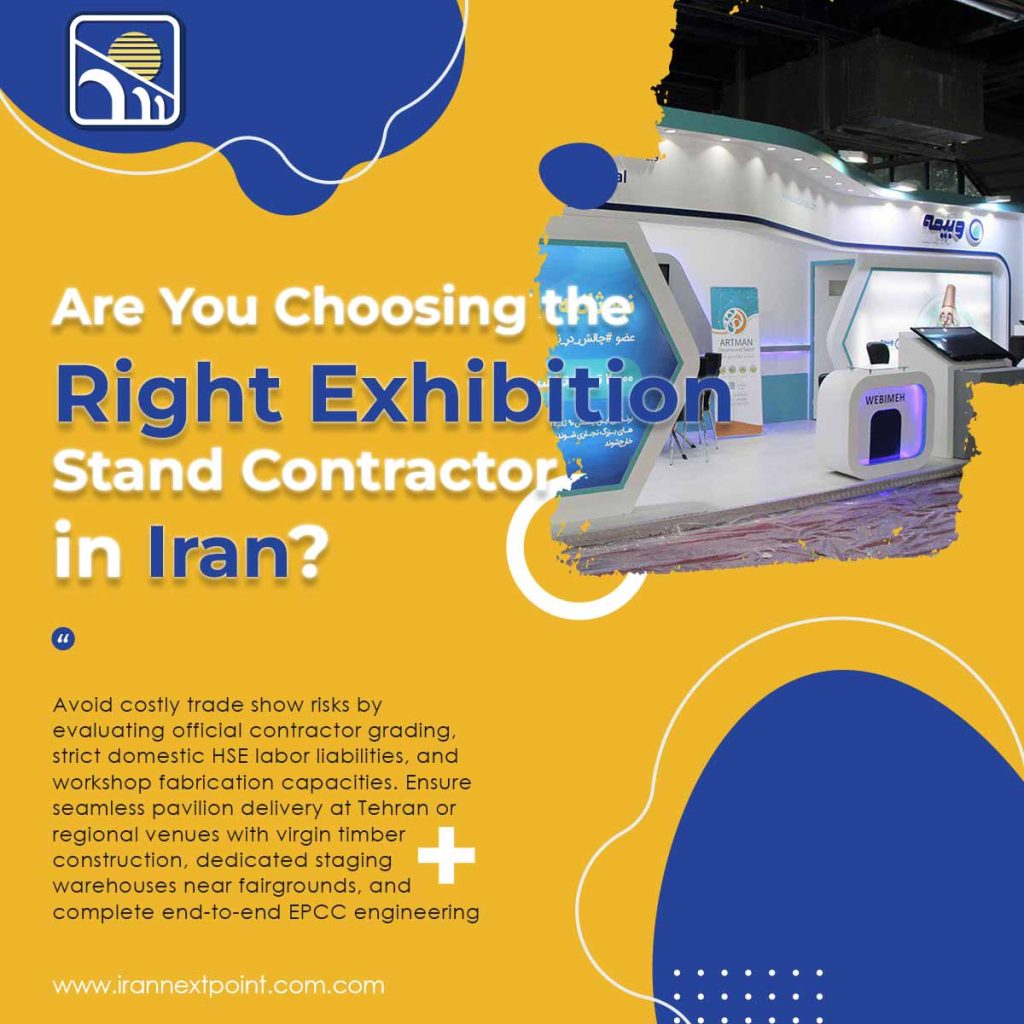
Navigating Trade Fair Execution in Iran: Practical Realities and Structural Verification
International participation in Iranian trade fairs offers unparalleled commercial access across industrial, mining, energy, and consumer markets. However, foreign commercial directors often face operational ambiguities when establishing their physical presence. Selecting a dependable exhibition stand contractor in Iran requires rigorous verification beyond superficial marketing promises. Misunderstandings regarding official licensing, venue logistics, labor liability, and structural material integrity can jeopardize exhibition investments. Therefore, international exhibitors must implement an objective due-diligence framework before signing binding construction agreements.
Exhibition venues operate under rigid timelines, municipal building codes, and complex logistics networks. Operating as a comprehensive Engineering, Procurement, Construction, and Commissioning (EPCC) contractor, IranNextPoint provides transparent advisory for international delegates. Foreign exhibitors must exercise their statutory rights, verify corporate backgrounds, and examine technical execution capabilities. Furthermore, cross-referencing upcoming trade dates within our comprehensive Iran exhibition calendar ensures adequate preparation lead time. To evaluate completed structures, examine our verified exhibition projects portfolio.
1. Demystifying Contractor Grading: Capacity Scaling Versus Construction Quality
The International Exhibition Organization of Iran administers a standardized grading system categorized from Grade A to Grade E. Foreign corporate delegates frequently misinterpret this classification as an indicator of architectural quality or craftsmanship. Consequently, exhibitors assume that a Grade A contractor builds superior pavilions compared to a Grade C contractor. This assumption is fundamentally incorrect and distorts vendor evaluations.
The domestic exhibition authorities treat all certified contractors equally in technical standards. The official grading framework measures physical operational capacity and simultaneous construction bandwidth rather than aesthetic superiority:
- Grade A Classification: Identifies contractors with massive administrative payrolls, extensive heavy tooling, and large-scale industrial facilities capable of executing up to 10 simultaneous booths totaling over 1,500 square meters.
- Mid-Tier Classifications (Grade B & C): Identifies specialized contractors with dedicated core engineering teams capable of handling 2 to 4 simultaneous pavilions totaling 300 to 800 square meters.
- Specialized Boutique Workshops: Capable of dedicating complete technical oversight to single custom pavilions without spreading supervision across excessive simultaneous sites.
The technical oversight bureau (Daftar-e Fanni) enforces this grading system to safeguard venue security and prevent vendor overcommitment. For instance, high-density industrial events like the International Oil Show present severe logistical bottlenecks. If an unmonitored contractor accepts twenty simultaneous pavilions without requisite capacity, execution collapses. Therefore, venue authorities verify equipment assets, workshop titles, and active staff payrolls before assigning capacity quotas. International clients must understand that holding any valid official grade confirms legitimacy. Your primary focus should center on whether the contractor can dedicate direct engineering attention to your specific plot.
2. The Exhibitor’s Legal Prerogative: Rejecting Monopolistic Contractor Impositions
A critical operational hurdle confronting international exhibitors involves improper pressure from certain event organizers. During booth space allocation, rogue commercial agents occasionally insist that clients contract exclusively with specific construction agencies. Some organizers falsely claim that utilizing outside builders will result in permit denials or administrative rejections. This practice is entirely unauthorized under standard fairground statutes.
International exhibitors possess an absolute, legally protected right to select any officially certified contractor. Venue administrations publish comprehensive rosters containing all certified, graded pavilion contractors. The organizer’s legitimate role remains strictly confined to distributing this authorized contractor list alongside contact records. Organizers possess no statutory authority to dictate vendor selection, establish closed construction cartels, or penalize independent contractor appointments.
This manipulative behavior occasionally occurs in regional exhibition venues, including provincial free zones like Kish Island. International enterprises must reject these monopolistic tactics firmly. At IranNextPoint, we provide transparent, complimentary consultations regarding your administrative rights across all regional trade centers. Whether you collaborate with our fabrication divisions or appoint another certified agency, we outline regulatory pathways openly. Never permit third-party organizers to compromise your architectural autonomy or inflate construction budgets under artificial pretexts.
3. Corporate Standing Versus Mere Licensing: The Danger of Paper Contractors
Holding an exhibition construction grade does not guarantee comprehensive institutional reliability. An exhibition license simply proves that an entity received hall access authorization. However, foreign corporate risk managers must distinguish between established commercial corporations and shell brokerages. Many license holders operate as virtual intermediaries, maintaining minimal office presence and outsourcing physical fabrication to informal sub-tier workshops.
Contracting with an intermediary introduces severe operational liabilities. Intermediaries maintain fragile accountability structures. If structural failures, electrical fires, or schedule collapses occur inside the hall, these paper entities frequently vanish from liability claims. Therefore, foreign corporations must conduct strict corporate background audits through established Iranian state databases:
- Official Entity Verification: Verify the contractor’s formal legal incorporation status via the official State Organization for Registration of Deeds and Properties.
- Official Gazette Tracking: Inspect verified director appointments, commercial capital updates, and authorized corporate signatures published in the Official Gazette of Iran.
- Physical Corporate Footprint: Ensure the vendor maintains registered, inspectable headquarters offices and actively processes monthly social security payrolls (List-e Bimeh).
- Institutional EPCC Integration: Confirm whether the contractor manages multi-disciplinary services through an integrated corporate legal compliance framework.
Contractors operating legitimate business structures maintain dedicated domestic corporate banking accounts and adhere to Iranian tax compliance laws. Verifying these administrative foundations shields your enterprise from financial malfeasance and ensures legally binding accountability throughout the exhibition lifecycle.
4. Severe HSE Compliance Realities: Mitigating Foreign Exhibitor Criminal Liability
International exhibitors frequently underestimate the severity of Iranian labor regulations and occupational safety frameworks. In many developing markets, enforcement around construction safety remains lax. In sharp contrast, the Iranian Social Security Organization (Tamin-e Ejtemaei) and municipal labor inspection courts enforce uncompromising legal codes. Iranian labor jurisprudence strongly favors workers in workplace accident adjudications.
Under Iranian law, the primary project commissioning entity—the foreign exhibitor—shares joint and several liability with downstream builders. If an uninsured worker falls from a scaffolding tower or suffers electrocution on your stand, severe legal consequences follow. Subcontractors lacking verified certifications frequently abandon accident scenes, leaving foreign corporate executives personally entangled in domestic criminal courts. Workplace fatalities or severe injuries trigger mandatory statutory blood money (Diyeh) compensations. These financial liabilities escalate significantly during sacred Islamic calendar months. Therefore, foreign directors must verify safety parameters aggressively:
- Valid HSE Certifications: Demand authenticated, currently active Health, Safety, and Environment (HSE) certifications issued by competent regulatory bodies.
- Comprehensive Civil Liability Insurance: Require written proof of active third-party liability insurance covering full statutory Diyeh compensation for all on-site personnel.
- Mandatory Personal Protective Equipment (PPE): Ensure the contractor enforces hard hats, safety harnesses, and insulated electrical gear during the critical four-day build-up window.
Never permit uncertified artisans to access your exhibition plot. Securing verified HSE documentation safeguards vulnerable workers, prevents sudden judicial hall closures, and protects foreign management from severe legal liabilities.
5. Strategic Staging Proximity: Overcoming Tehran’s Crippling Traffic Gridlock
Spatial positioning and logistics proximity play decisive roles in temporary exhibition success. The Tehran International Permanent Fairground occupies a congested urban pocket along the elevated Shahid Chamran Expressway. Heavy structural freight haulage occurs strictly during nighttime delivery windows when urban avenues permit commercial flatbed trucks. However, daytime emergency logistics present an entirely different operational crisis.
Exhibition components inevitably face operational stress during live events. High-capacity water dispensers malfunction, digital display cards fail, or specialized electrical transformers overload under unexpected utility spikes. An exhibition contractor whose only warehousing sits in distant suburban industrial parks cannot execute daytime emergency repairs. Heavy traffic surrounding the venue makes rapid cross-city transit impossible during business hours.
IranNextPoint resolves this vulnerability through deliberate spatial decentralization. While our heavy industrial manufacturing workshops operate within organized industrial estates, we maintain an active technical staging warehouse directly in Evin. Situated minutes from the fairground’s northern gates, our Evin facility stores critical replacement modules, spare lighting transformers, and backup plumbing components. Furthermore, our corporate engineering headquarters operates in Evin, allowing technical specialists to reach trade halls within thirty minutes. When planning exhibition operations, foreign participants should cross-reference regional trade fairs in our trade exhibition calendar.
6. Hall Intelligence and Trade Fair Topography: Avoiding Structural and Foot-Traffic Traps
Trade fair floor layouts rarely follow predictable numeric sequences. At the Tehran International Fairground, Hall 8 and Hall 9 occupy the most coveted pedestrian thoroughfare across the central grounds. Conversely, adjacent Halls 10 and 11—despite sharing sequential numbers—feature lower visitor conversion rates due to segmented access ramps. Furthermore, Halls 14 and 15 suffer from restrictive ceiling clearances that complicate suspended structural cantilevers.
An experienced exhibition contractor must provide strategic guidance regarding hall selections, electrical capacities, and seasonal microclimates:
- Electrical Substation Vulnerabilities: Specific older halls, including Hall 38B, experience documented electrical phase instability. Heavy industrial exhibitors running high-draw hydraulic pumps or industrial compressors require independent voltage stabilizers and private power drops.
- HVAC and Seasonal Extremes: Tehran experiences harsh temperature swings between scorching summers and freezing continental winters. Booths positioned directly adjacent to primary roll-up loading bay doors suffer from severe thermal drafts, requiring supplemental climate control.
- Perimeter Foot-Traffic Orientation: Empirical pedestrian analysis shows that trade delegates veer rightward upon entering wide-span halls. Structural focal walls and digital display totems must align with natural pedestrian viewing angles.
- Logistical Access and Egress Gates: The fairground’s southern perimeter gates generate chronic vehicle gridlock at evening closing times. Coordinating private transport via northern egress avenues through Yemen Street cuts transit times substantially.
Selecting an exhibition contractor with granular knowledge of hall-specific infrastructure prevents operational failures and maximizes your marketing investment.
7. Carpentry Material Integrity: Virgin Substrates Versus Warped Recycled Boards
Temporary trade show construction often tempts low-cost builders into aggressive material compromises. One widespread industry shortcut involves the unauthorized reuse of recycled chipboard (Neopan) panels recovered from demolished previous displays. In domestic timber supply chains, price disparities between virgin engineered panels and second-hand scrap boards remain substantial. Contractors operating without strict oversight quietly utilize recycled materials to inflate profit margins.
Using recycled chipboard introduces visible architectural flaws across exhibition walls:
- Asymmetric Moisture Curvature: Chipboard panels coated with paint on one surface absorb ambient atmospheric humidity unevenly. Consequently, recycled boards develop permanent lateral warping and concave wall bows.
- Surface Irregularities: Warped substrates prevent level horizontal alignment, creating visible seams, peeling graphic vinyls, and misaligned display shelving.
- Structural Brittleness: Previously screwed chipboard cores lose internal cohesion, compromising structural screw retention under load-bearing cantilever moments.
International corporate brands must mandate the exclusive use of virgin, factory-flat medium-density fiberboards (MDF) or premium grade raw chipboards within formal bid tenders. Demanding verified timber origin documentation guarantees crisp orthogonal edges, uniform wall finishes, and structural stability across multi-day exhibitions.
8. Temporary Customs Protocols: Avoiding Punitive Port Cargo Fines
Bringing high-value industrial equipment, functional prototypes, or luxury retail samples into Iran involves strict regulatory procedures. Many foreign exhibitors operate under the misconception that exhibition cargo moves across borders without formal documentation. In reality, the Islamic Republic of Iran Customs Administration (IRICA) applies stringent oversight to trade fair consignments entering the country under temporary admission status.
Under Article 133 of domestic customs regulations, foreign goods destined for exhibition display enter under temporary admission bonds. This statutory facility waives standard commercial import tariffs, provided the cargo re-exports within statutory deadlines. If an exhibitor modifies, processes, sells, or damages temporary admission machinery without customs approval, harsh penalties apply. Customs authorities classify unauthorized alterations as illegal commercial diversion, triggering retroactive import duties and substantial administrative fines.
A competent exhibition contractor coordinates with fairground customs desks to secure temporary admission manifests, process ATA Carnet documentation, and manage bonded transit warehouses. Reviewing these requirements in our corporate legal framework ensures full regulatory compliance throughout the exhibition cycle.
9. Integrated Lifecycle Partnerships: Beyond the Four-Day Exhibition Horizon
More than ninety percent of domestic exhibition builders operate solely as transient booth makers. Once fairground maintenance teams dismantle the pavilion, their commercial engagement terminates entirely. However, foreign industrial brands rarely visit Iran merely to display machinery for four days. The exhibition serves as a preliminary gateway toward establishing corporate branches, securing commercial distribution, and opening retail showrooms.
Collaborating with an integrated general contractor eliminates administrative friction. If your market entry strategy expands from exhibition marketing into nationwide store rollouts, our specialized turnkey retail construction divisions deliver rapid modular store fit-outs across major commercial districts. Furthermore, our corporate advisory units manage foreign branch registrations, trademark filings, and capital protections under the Foreign Investment Promotion and Protection Act (FIPPA).
Contracting with an established partner provides foreign enterprises with operational continuity across every commercial phase. We bridge immediate trade show requirements with comprehensive long-term corporate positioning, securing your investments through transparent execution and deep regulatory expertise.
For confidential technical reviews, floor plan evaluations, or detailed quotations, contact our engineering divisions directly. Connect with our primary design studio at design@irannextpoint.com, submit construction tenders to projects@irannextpoint.com, or consult our corporate directors through our corporate contact portal.
Pingback: Tehran International Fairground Regulations: Complete Technical, Safety, and Structural Guidelines for Foreign Exhibitors - IRAN Next Point | Exhibition Stands & Turnkey EPCC Corporate Setup
Pingback: Temporary Customs Clearance for Iran Exhibitions: Comprehensive Guide to Article 133, ATA Carnet, and Venue Logistics - IRAN Next Point | Exhibition Stands & Turnkey EPCC Corporate Setup
Pingback: Exhibition Stand Construction Costs in Iran: A Transparent Budgeting and Cost-Breakdown Guide for Foreign Exhibitors - IRAN Next Point | Exhibition Stands & Turnkey EPCC Corporate Setup
Pingback: Iran Market Entry Beyond Trade Shows: Converting 4-Day Exhibitions into Permanent Commercial Presence - IRAN Next Point | Exhibition Stands & Turnkey EPCC Corporate Setup
Pingback: Modular Click Booth Iran: Proprietary Lightweight Aluminum System for Fast-Track Exhibition Deployments - IRAN Next Point | Exhibition Stands & Turnkey EPCC Corporate Setup
Pingback: Iran Exhibition Stand Builder Guide: Top 10 High-Traffic Trade Shows, Hall Dynamics, and Strategic Venue Regulations - IRAN Next Point | Exhibition Stands & Turnkey EPCC Corporate Setup
Pingback: Turnkey Retail Iran: Strategic Roll-Out Strategies, Localized Fit-Out Engineering, and Municipal Compliance - IRAN Next Point | Exhibition Stands & Turnkey EPCC Corporate Setup
Pingback: Exhibition Stand Pricing Iran: Comprehensive Guide to Structures, Transparent Cost Breakdowns, and Strategic Budgeting - IRAN Next Point | Exhibition Stands & Turnkey EPCC Corporate Setup
Pingback: Corporate Event Management Iran: Comprehensive VIP Infrastructure, Audiovisual Engineering, and Regulatory Compliance - IRAN Next Point | Exhibition Stands & Turnkey EPCC Corporate Setup
Pingback: Iran Exhibition Stand Builder Master Guide: Localized VIP Architecture, Advanced Material Engineering, and Trade Show Craft - IRAN Next Point | Exhibition Stands & Turnkey EPCC Corporate Setup
Pingback: First Time Exhibitor Iran: The Essential Regulatory, Logistics, and Stand Construction Guide - IRAN Next Point | Exhibition Stands & Turnkey EPCC Corporate Setup
Pingback: Exhibition Logistics Iran: Comprehensive Customs Clearance, Asset Security, and Bilingual Staffing Solutions - IRAN Next Point | Exhibition Stands & Turnkey EPCC Corporate Setup
Pingback: Company Registration Iran: Master Guide to Legal Structuring, Commercial Real Estate, and Bureaucratic Compliance - IRAN Next Point | Exhibition Stands & Turnkey EPCC Corporate Setup
Pingback: Retail Facility Management Iran: Strategic Infrastructure, IT Security, ESG Compliance, and Human Resource Alignment - IRAN Next Point | Exhibition Stands & Turnkey EPCC Corporate Setup
Pingback: B2B Exhibition Iran: Strategic Negotiation Hubs, VIP Corporate Logistics, Brand Localization, and Permanent Retail Integration - IRAN Next Point | Exhibition Stands & Turnkey EPCC Corporate Setup
Pingback: Corporate Solutions Iran: Master Guide to Intellectual Property, Labor Compliance, Supply Chains, and Executive Relocation - IRAN Next Point | Exhibition Stands & Turnkey EPCC Corporate Setup
Pingback: Exhibition Safety Iran: Strategic Guide to Fairground HSE, Utility Management, Site Surveying, and Sustainable Decommissioning - IRAN Next Point | Exhibition Stands & Turnkey EPCC Corporate Setup
Pingback: Modular Click Structures: Strategic Engineering, Backlit Illumination, and Rapid Corporate Market Entry in Iran - IRAN Next Point | Exhibition Stands & Turnkey EPCC Corporate Setup
Pingback: Remote EPCC Iran: Strategic Project Governance, Customs Logistics, Infrastructure Quality, and Milestone Financial Structuring - IRAN Next Point | Exhibition Stands & Turnkey EPCC Corporate Setup
Pingback: Exhibition Stand Contractor Iran: Mitigating Hidden Risks via Parallel EPCC Execution and Strategic Architecture - IRAN Next Point | Exhibition Stands & Turnkey EPCC Corporate Setup
Pingback: Iran Exhibition Stand Contractor: Navigating Currency Volatility, Inflation Hedging, and Secure Cross-Border Project Governance - IRAN Next Point | Exhibition Stands & Turnkey EPCC Corporate Setup
Pingback: Iran Exhibition Stand Contractor: Managing the 96-Hour Crisis Assembly Marathon in Tehran - IRAN Next Point | Exhibition Stands & Turnkey EPCC Corporate Setup
Pingback: Iran Exhibition Stand Contractor: Strategic Pavilion Layout Engineering, Aisle Traffic Analysis, and Spatial Zoning - IRAN Next Point | Exhibition Stands & Turnkey EPCC Corporate Setup
Pingback: Iran Exhibition Stand Contractor: Mastering Parallel EPCC Execution, 4-Day Chronology, and Permanent Retail Expansion - IRAN Next Point | Exhibition Stands & Turnkey EPCC Corporate Setup
Pingback: Exhibition insurance in Iran: verify organizer liability policies, audit compensation limits, and protect your stand assets. - IRAN Next Point | Exhibition Stands & Turnkey EPCC Corporate Setup
Pingback: Iran Exhibition Booth Builder Case Study: Overcoming Asymmetrical Floor Geometry at Tehran Fairgrounds - IRAN Next Point | Exhibition Stands & Turnkey EPCC Corporate Setup
Pingback: Iran Exhibition Stand Builder: Managing Electrical Utility Standards, Heavy Machinery Power, and Fairground HSE Compliance - IRAN Next Point | Exhibition Stands & Turnkey EPCC Corporate Setup